Showing posts with label Communism. Show all posts

Tuesday, May 27, 2008

Ho Chi Minh


Ho Chi Minh gained support and power in North Vietnam through the Chinese communists, whose military and economic contributions allowed Minh to establish a North Vietnamese government after the French left the area. In December of 1960, Minh formed the North Vietnamese military, the National Front for the Liberation of South Vietnam (NLF) also known as the Vietcong. The reason why Minh was able to gain so much power was through the separation of knowledge (so interrogation did not serve much of a purpose) and the fostering of alliances with peasants, which is why the Vietnam War was so hard to fight

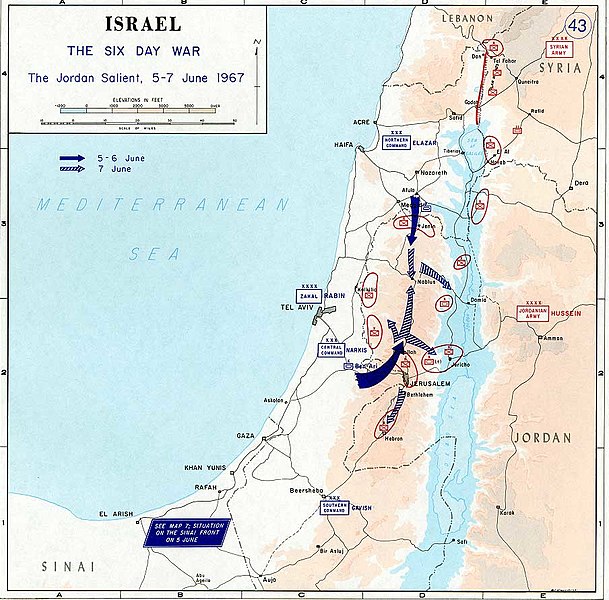
The Six-Day War


The U.S. became involved in the Middle East in the 50’s; after the Iraqi revolution, the U.S. had slightly fluctuating relationships with surrounding countries. In 1962, President Nasser (Egypt) sent troops to fight the Saudi Arabians, who the U.S. backed. In 1963, the U.S. sent aid to Israel in the form of weapons. Johnson withdrew Egyptian aid, allowing the Egyptians to shift further into the Soviet arms. The call for American involvement was also supported by the U.S. statement of 1956 that declared that any Egyptian blockage of the straight of Tiran would be regarded as an act of war. On May 22, 1967, the Egyptians finally made this move. Johnson warns the Israelites not to attack first, but while the Syrians, Egyptians, and Jordanians were moving into position, Israel and the U.S. struck, claiming ultimate victory, albeit shaky.
More interesting and in-depth info can be found here and here.

Great Society

Upon Johnson’s entrance into office, he proposed his plan that he entitled “Great Society.” It was his “War on Poverty,” in which he created two new cabinet offices: The Department of Transportation and the Department of Housing and Urban Development. These programs put families on welfare, milking over 3 billion dollars from national funds to the Office of Economic Opportunity. Johnson signed four different bills concerning each of the following: education, medical care, immigration reform, and voting rights. Johnson’s plan would be responsible for most of the legislation to occur in the decade.

The Assassination of John F. Kennedy

On November 22, 1963, Kennedy was shot in a parade. The gunman was Lee Harvey Oswald, a communist who was hiding in a school warehouse. Oswald was then assassinated by nightclub owner, Jack Ruby. Johnson was sworn in on Air Force One quickly following the action that had ensued. Theories abound as to the real force behind the assassination, but whether or not it was a conspiracy is still unknown. 7 Days after the assassination, Johnson set up the Warren Commission, led by Chief Justice Earl Warren, to collect information about the assassination and make a formalized report. Also notable was the formation of The House Select Committee on Assassinations, which also investigated the assassination of Martin Luther King Jr.

Cuban Missile Crisis

In October of 1962, aerial photographs were taken over Cuba. They exposed the transportation of nuclear missiles from the U.S.S.R. to Cuba, where America would be in firing range. Kennedy refused the bombing of the missile sites. On the 22nd of October, Kennedy placed a naval blockade on Cuba, which would be moved on the circumstance of the removal of the nuclear warheads. Also, should any attack occur, Kennedy stated that the U.S. would retaliate by firing nuclear missiles at Russia, from the Turkish base sites under American control. The soviets placed a naval ring surrounding the U.S. quarantine, yet no shots were fired for fear of nuclear destruction of the world’s top leading countries. On the 28th, the U.S. and Soviets reached an agreement: the removal of nuclear weapons in both Turkey and Cuba. Perhaps one of the most tense moments of the sixties, the event ultimately gave Kennedy more popular support, as well as spurned scares and parodies in popular culture, such as the 1964 film, Dr. Strangelove Or: How I Learned to Stop Worrying and Love the Bomb.

Bay of Pigs

Eisenhower had already set up the take-down of Fidel Castro using CIA agents. Kennedy wanted no direct intervention, and instead provided arms and supplies for the anti-Castro rebels (1200 exiles). The attack proved a dismal failure, as Kennedy refused to supply crucial support to the uprising. In the end, all of the exiles were captured or killed, and the U.S. paid a ransom of 62 million in pharmaceuticals and other supplies to the Cuban government. This attack proved nothing and deterred the Cubans even more forcefully to the Soviet side.

Cuba and Communism

In 1959, Fidel Castro had finally garnered a victory in his rebellion against Fulgencio Batista, the former leader. Castro began seizing American held land and redistributing it. The U.S> then cut off heavy importation of Cuban sugar and other resources (cobalt, nickel, iron ore, chromium, copper, salt, timber, silica, petroleum, and arable land). This led to more seizure of land by Castro’s new dictatorship. The United States finally broke diplomatic relations in 1961 and in the same year, placed a lasting embargo on Cuban products. As Cuba backslid towards communism, building ties with other communist countries, tensions between the U.S. and Cuba grew, leading to the Cuban Missile Crisis and continuing on to the present.
Find the present-day CIA dossier on Cuba by clicking here.